


How Enhanced Detector Stability Leads to Improved GPC/SEC Results

Introduction
GPC (Gel Permeation Chromatography) or SEC (Size-Exclusion-Chromatography is widely acknowledged as one of the most useful characterization methods in polymer science. The technique offers the possibility to determine molecular weight distribution and its averages, to provide a complete picture of the polymer sample under investigation.
In standard GPC/SEC, after column separation, a concentration detector is typically used to record a signal proportional to the relative concentration of the sample. As most synthetic polymers are not UV active, a Differential Refractive Index (DRI) detector is most commonly used for this task. Prior knowledge of the samples specific refractive index increment (dn/dc) also allows determination of absolute concentration of the sample.
With a single measurement taking up to 60 minutes and the resultant chromatogram having to be related to a calibration curve obtained several days before - GPC/SEC can be a time-consuming technique. As a consequence, accurate calculation of molecular weight using GPC/SEC is highly dependent on baseline stability. These facts underline the importance of minimizing DRI detector signal drift in a GPC/SEC system.
This technical note describes how the design of a differential refractive index detector has been improved to provide reduced baseline drift and thus improve overall GPC/SEC system performance increasing accuracy of results.
The way it was
Differential refractive index detectors, often called DRI detectors, respond to the universal mass property of the analyte - its refractive index - and detect peaks based on the difference in refractive index between the analyte and the pure mobile phase.
While this property makes the DRI detector universally applicable, it also poses a problem as the detector will also be sensitive to any other factor that affects the refractive index. The main factors which have influence on the signal obtained are mobile-phase composition and temperature.
How DRI detectors work
There are some specific design differences between detectors from different manufacturers, but most share the elements of the generic detector shown in Figure 1.
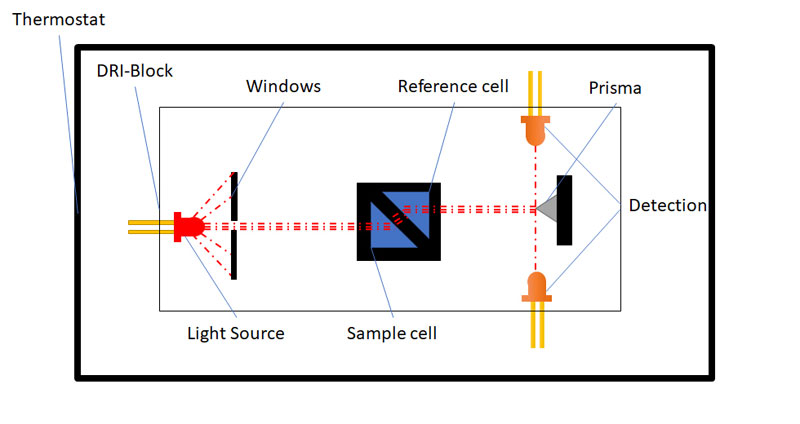
The core of any DRI detector is built around a split flow cell. One side of the cell is reserved for the pure solvent reference. The other side is for the eluent flow from the sample separation exiting the GPC/SEC columns. The difference in Refractive Index between the two sides of the cell translate into a change in the position of the light beam passing through the cell, which will then be detected. It is important to note that in most DRI detectors, the reference solvent is kept static and must be frequently exchanged with fresh solvent to avoid baseline signal variation.
Why do I observe drift in my GPC System?
First, we need to understand the difference between baseline noise, drift and the smallest detectable peak. This is illustrated in Figure 2 below.
Baseline noise is a very critical factor in RI detection. The refractive index change is a relatively low sensitivity phenomenon compared to UV absorption. The signal-to-noise ratio of an RI detector is therefore more affected by the noise, defined as the random signal variation at baseline level.
Baseline drift is the trend of deviation from the zero-slope course resulting in a comparatively long-term change of the signal value.
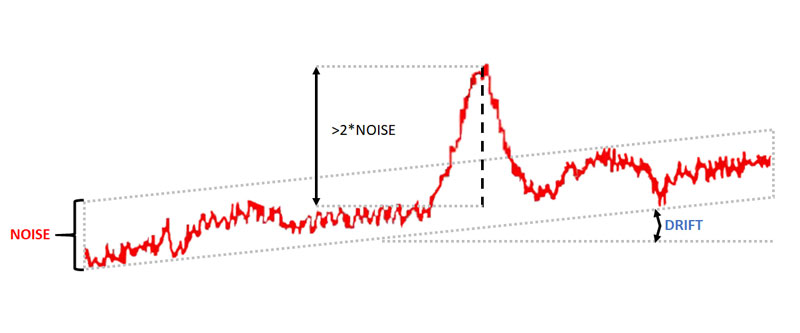
The smallest detectable peak is defined as a peak larger than twice the noise. This criterion is often referred to as the “2-Sigma” criterion, meaning that a signal larger than two time the standard deviation of the baseline signal can be considered a peak value.
Under the assumption of perfect identity between the solvent in the reference and in the sample side of the cell, temperature is the parameter with the most pronounced impact on baseline stability. Depending on the solvent in use, a change of just 1 °C in temperature can turn into a change in refractive index in the range of 10-4 Δn. This equates to around 10% of the dynamic range of most DRI Detectors. This implies that temperature stability in excess of 10-3 °C must be achieved in order to obtain a significantly stable baseline over several hours.
The novel approach
As described above, temperature stability plays a crucial role in signal stability of a DRI Detector. Testa Analytical Solutions novel approach to this well-known problem resulted in the development of a new technological solution which offers a significant improvement in the stability of a DRI Detector. This approach takes advantage of advanced insulation materials and of a self-adjusting algorithm for the electronic control of temperature of the complete optical assembly. This combination allows reliable use of DRI detectors over a wide temperature range up to 80 °C while keeping baseline drift to a minimum compared to other commercial RI detectors.
Experimental demonstration of our DRI detector
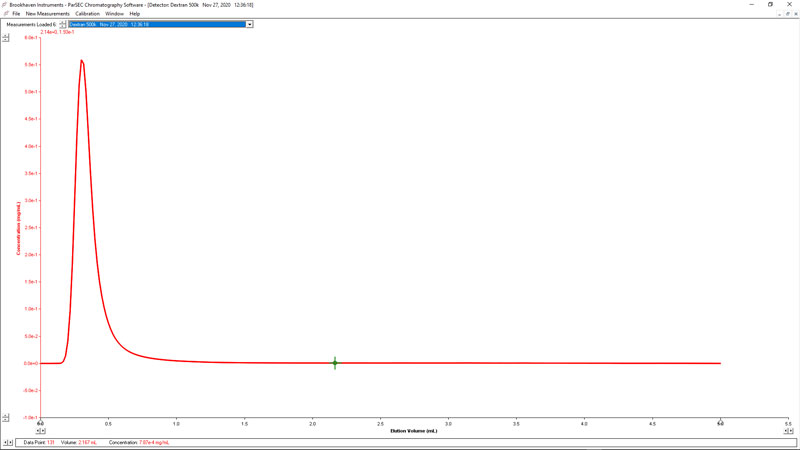
To test the performance of this novel DRI detector we undertook measurements using several different solvent systems and at several different temperatures to demonstrate its applicability for the widest range of GPC/SEC applications. Display or discussion of such an amount of data is impossible in the context of this short technical note. However, to demonstrate the outstanding stability of our DRI detector design - Figure 3 shows a short segment of a measurement done over several days at 1 mL/min. The peak shows signal of a 1 mg/mL sample followed by baseline for several minutes.
Conclusions
Figure 3 clearly shows the ability of Testa Analytical Solutions’ enhanced DRI detector to produce reduced baseline drift and improved performance in any GPC/SEC system, leading to an improvement in the accuracy of the results. Further technological developments of the DRI detector, which result in further performance benefits, will be described in future technical notes.
Thank You!

Your message has been forwarded to our team and we will reply as soon as possible. Thank you for your patience.
© 2026 TESTA Analytical Solutions e.K. All rights reserved.