


Using Static Light Scattering to Measure Polymer Molecular Weights

What is Static Light Scattering?
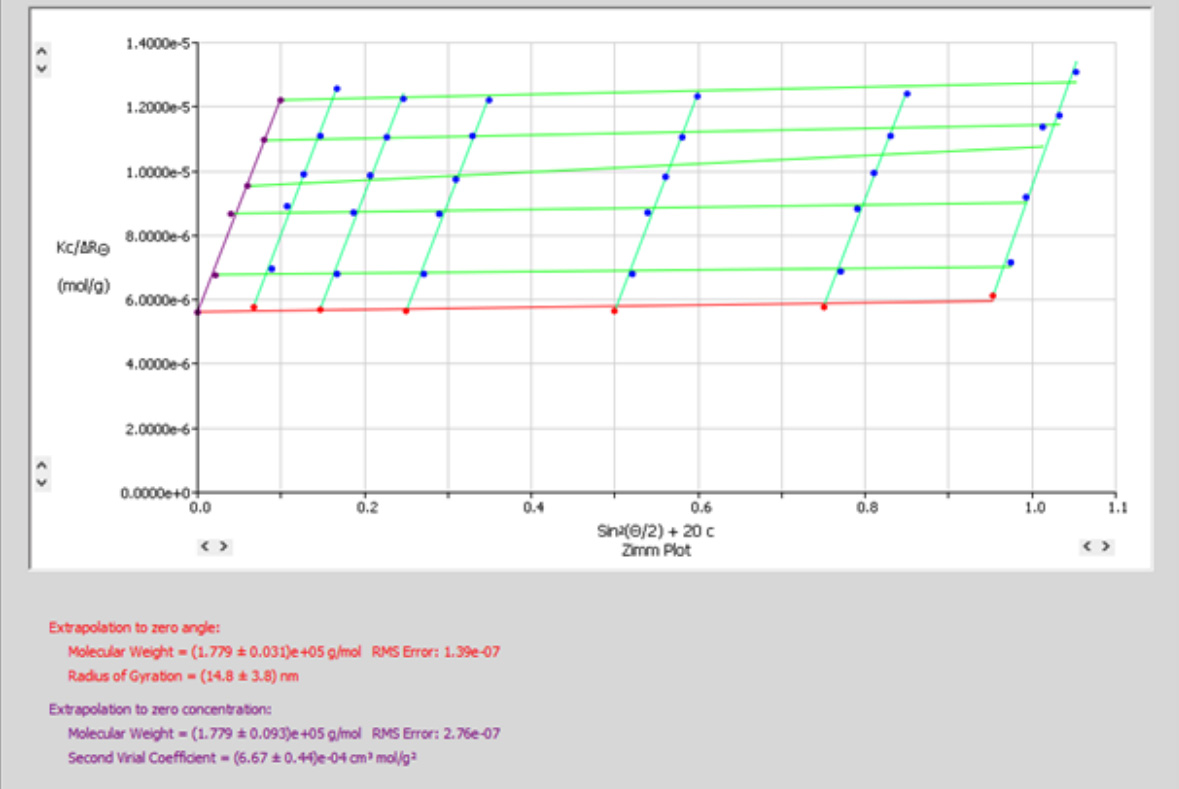
Static light scattering (SLS) is a technique that leverages high precision photon counting to measure size, molecular weight, and other structural parameters. Common samples include synthetic polymers, nanoparticles, biomolecules, and other macromolecules. SLS makes extensive use of extrapolation, typically with respect to scattering angle, concentration, or in the case of the Zimm Plot, a dual extrapolation.
How is Static Light Scattering Different from Dynamic Light Scattering (DLS)?
Photon Counting vs. Autocorrelation
In both cases, molecules are in motion, but whereas DLS emphasizes rapid fluctuations in intensity due to Brownian motion, SLS emphasizes photon counting such that very accurate measurements of the time-averaged intensity of scattered light are made. While DLS and SLS produce complimentary information, they rely on fundamentally different principles to do so. DLS is fundamentally a measure of motion, or diffusion speed, something that can be related to a hydrodynamic size through the Stokes-Einstein expression which relates the translational diffusion coefficient, DT, to the hydrodynamic diameter, dh. In contrast, SLS is fundamentally a structural technique.
Scattering Angles
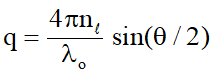
Angle dependence is a core feature of static light scattering. The intensity of scattered light can either be plotted as a function of scattering angle, Θ, or scattering vector, q. The scattering vector, sometimes referred to as the momentum transfer vector in small-angle scattering literature, is a function of Θ, the wavelength of light in a vacuum, λo and the refractive index of the medium, ni.
Optimised Performance vs Speed of Use
The form of a particular particle or polymer gives rise to a geometric function describing its shape. This function, sometimes written as P(Θ), describes the angle dependence of scattered light. For pure liquids and very small particles, this term appears constant over the typical angular range of a goniometer-based SLS experiment.
Conventional applications of SLS:
The Zimm Plot
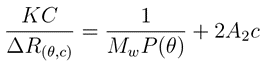
The Zimm Plot is one of the best-known models used to fit SLS data and is the canonical method for determining polymer molecular weights. The Zimm Equation requires angle and concentration dependent measurements be made. This data can be acquired using either a goniometer or a MALS instrument. This method must be used for any primary particle large enough to exhibit angle dependence.
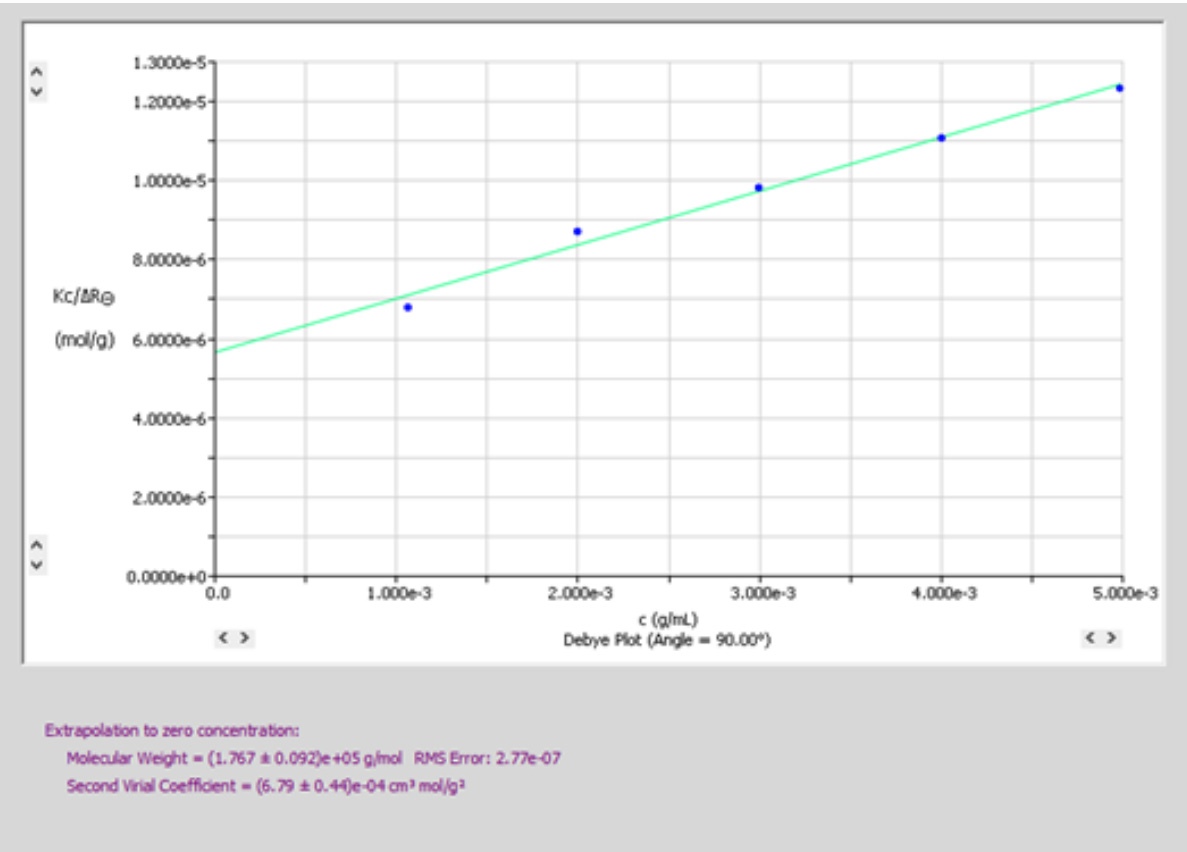
The Debye Plot
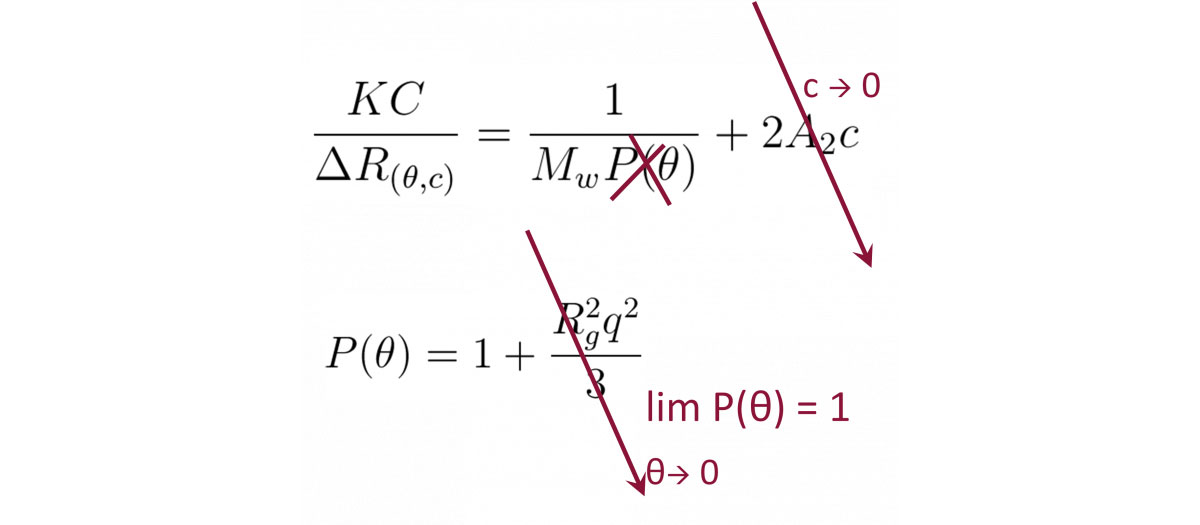
For smaller particles and for low MW polymers for which there is minimal angle dependence, it is possible to simplify the Zimm Expression such that only a single scattering angle is required. This simplification starts to break down for Rg greater than about 20 nm, and should therefore be used with care.
Advantages:
The Debye plot does not require a multi-angle instrument.
Disadvantages:
The approximation becomes increasingly poor as MW or Rg increase.
Thank You!

Your message has been forwarded to our team and we will reply as soon as possible. Thank you for your patience.
© 2026 TESTA Analytical Solutions e.K. All rights reserved.